
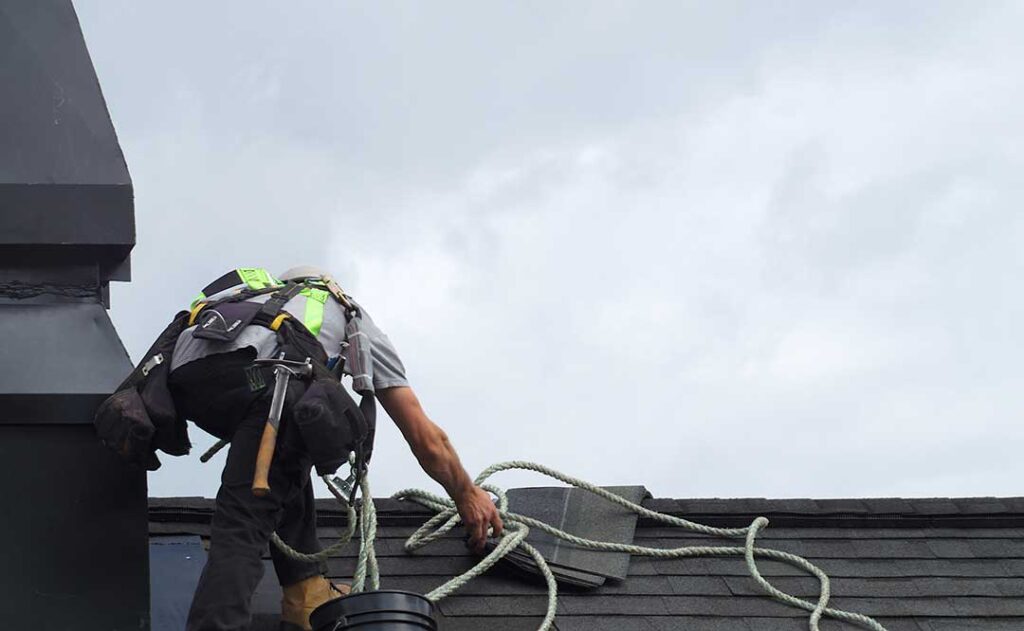
Roof drainage is the system that moves rain, melting snow, and ice away from the roof and foundation. In Albany, NY, that system must handle seasonal downpours, freeze-thaw cycles, heavy leaf fall, and snow that can remain on a roof for extended periods.
Good drainage protects more than shingles. It helps reduce damage to fascia boards, soffits, siding, windows, masonry, landscaping, basements, and foundation walls.
How should water leave a residential roof?
Water should follow a continuous path from the roof surface into gutters, through downspouts, and away from the foundation. Every part of that route needs to be open, properly sloped, securely attached, and directed toward a suitable discharge area.
A reliable drainage path usually includes:
- Roof slopes that direct water toward the eaves or internal drains
- Gutters positioned to collect runoff without allowing water to flow behind them
- Downspouts placed near roof valleys and other high-volume collection points
- Extensions or underground outlets that discharge water well away from foundation walls
- Splash control at the ground to limit erosion and soil movement
A gutter system is not working properly if water spills over the front edge, backs up behind the gutter, drains beside the foundation, or remains pooled on the roof.
Why does roof drainage require special attention in Albany?
The local climate creates several drainage challenges. Rain can arrive during spring storms and summer thunderstorms, while autumn leaves can block gutters and downspout openings. Winter brings snow, ice, and repeated melting and refreezing.
Freeze-thaw conditions are especially hard on drainage components. Water trapped in a gutter or downspout can freeze, expand, and loosen fasteners or seams. Ice can also block the normal flow path, causing meltwater to collect behind the gutter or beneath roof edges.
Older housing adds another factor. Many area homes have been altered over time with additions, enclosed porches, dormers, or roof sections built at different elevations. These changes can create concentrated runoff that the original drainage system was never designed to handle.
What is the correct way to maintain gutters?
Gutters should be checked and cleaned before winter and again after the main leaf-fall season. They may also need attention after a major storm.
Maintenance should include:
- Removing leaves, roof grit, twigs, and compacted sediment
- Checking that water flows freely toward each outlet
- Looking for sagging sections where water can pool
- Inspecting seams and end caps for leaks
- Tightening or replacing loose hangers and fasteners
- Confirming that downspout outlets are not blocked
- Checking whether water is spilling behind the gutter
Cleaning from the ground is often incomplete because blockages may be hidden near the gutter outlet or inside the upper section of a downspout. A visible gutter can look clear while the outlet remains obstructed.
Avoid leaning ladders against unstable gutters. Ladder work becomes more hazardous when surfaces are wet, icy, or near overhead utility lines.
How far should downspouts discharge water?
Downspouts should release water far enough from the foundation that runoff cannot flow directly back toward the building. The exact distance depends on soil, grade, landscaping, foundation conditions, and whether the outlet connects to a buried drainage line.
The discharge area should:
- Slope away from the building
- Resist erosion
- Avoid concentrating water beside basement walls
- Stay clear of walkways and entrances
- Avoid sending water onto neighboring property
- Remain accessible for inspection and clearing
Short downspout outlets that end beside the foundation are a common problem. They may appear adequate during light rain but can release hundreds of gallons near the foundation during a strong storm.
Buried extensions can improve appearance and drainage, but they also require maintenance. If the outlet becomes blocked or freezes, water may back up toward the downspout and gutter. Any underground system should have a known discharge point that can be inspected.
What should happen at roof valleys?
Roof valleys collect runoff from two sloping roof sections, so they often carry much more water than a typical roof edge. Gutters below valleys need special attention because concentrated water can overshoot the gutter or overwhelm a small downspout.
Common improvements include:
- Positioning a downspout close to the valley discharge area
- Using properly aligned valley flashing and underlayment
- Installing a wider or higher-capacity gutter where conditions require it
- Adding splash guards or diverters when water jumps over the gutter
- Keeping nearby gutters free of leaves and roof debris
A diverter can help control runoff, but it should not redirect water onto a roof edge, wall, walkway, or neighboring area where it creates a new problem.

How do snow and ice affect drainage?
Snow and ice should not be treated as ordinary roof debris. Removing them from a roof can be dangerous and may damage shingles, flashing, gutters, or the roof surface if done with improper tools.
Ice dams form when heat loss melts snow on warmer sections of a roof while colder eaves allow refreezing. The resulting ice can block drainage and force water beneath roof coverings. Proper attic insulation, air sealing, ventilation, and balanced roof-edge temperatures are usually more effective than repeatedly removing visible ice.
Warning signs include:
- Icicles accompanied by water stains or dampness
- Frost or moisture in the attic
- Repeated winter leaks near exterior walls
- Gutters pulling away after snow or ice accumulation
- Large ice formations along roof edges
Snow guards, heat cables, and other devices may be appropriate in specific situations, but they do not replace sound roof design, ventilation, and unobstructed drainage.
Can roof water be connected to a storm drain?
That depends on the property, the drainage design, and applicable local requirements. Roof runoff should not be routed into a sanitary sewer. Some underground connections may also be restricted or unsuitable because they can overload drainage infrastructure or transfer problems to another part of the property.
Before changing buried drainage, verify where existing pipes lead and whether the proposed discharge location is allowed. A system that disappears underground is not automatically a functional stormwater system.
For homes with low points, frequent basement seepage, or steeply sloped lots, roof drainage may need to be considered alongside grading, foundation drainage, sump discharge, and surface runoff.
What are signs of a roof drainage problem?
Some signs appear on the outside of the house, while others show up indoors.
Watch for:
- Overflowing gutters during moderate rain
- Water stains on soffits, fascia, ceilings, or upper walls
- Peeling paint or rotting wood near roof edges
- Soil erosion below downspouts
- Damp basement corners after storms
- Moss or algae in areas that stay wet
- Cracks or staining on foundation walls
- Gutters that sag or separate from the roofline
- Water pooling on a low-slope roof
A single symptom may have more than one cause. For example, a basement leak can result from roof runoff, grading, foundation cracks, subsurface drainage, or several conditions at once.
When does drainage work become a safety or code issue?
Drainage work requires extra caution when it involves steep roofs, fragile surfaces, ice, electrical hazards, structural changes, or buried utility lines. Roofs with internal drains, parapets, or low slopes may also require design details that differ from ordinary sloped-roof gutters.
New York’s residential code addresses roof drainage, gutter slope, watertight joints, roof drains, and emergency overflow provisions in applicable situations. Requirements can vary by building type and project scope, so drainage changes made during construction or roof replacement should be evaluated against the current code requirements.
The most dependable drainage system is not necessarily the most elaborate. It is the one that collects water continuously, remains accessible for maintenance, discharges safely, and continues working through rain, leaves, snow, and freeze-thaw weather.
